Many Reasons to Love Yucatan
There are many reasons to love Yucatan. In this video, narrator and co-writer of the travelogue, Yucatan Travel: Cancun to Chichen Itza, Miriam Balsley describes 12 of the reasons she loves Yucatan Mexico.
From swimming and snorkeling in the warm tropical waters of the Riviera Maya, to exploring mysterious lands and ancient Mayan ruins, to the shopping and nightlife of Cancun, to the rich cultural heritage of the Maya peoples, to the world-renown Chichen Itza pyramids, the Yucatan Peninsula is a magical place. Here’s a short video showing the many things to love about Yucatan:
Continue readingHealed by a Curandero – a Mayan Traditional Healer
Guest blog post by Kristine Ellingson, an excerpt from her book:
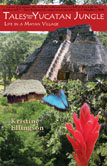
Tales from the Yucatan Jungle:
Life in a Mayan Village
by Kristine Ellingson
Chapter Fifteen
Curanderos
The next time I am to come up against something I cannot explain it is a shamanic experience, a curandero.
* * *
I burn my left hand with grease splatters while cooking. Being distracted by the girls, I have not paid attention. I have four large burn blisters on the back of my fingers and thumb. I put
Continue readingSafety in Yucatan Peninsula for Women
Twenty-one years living in Yucatan has given Kristine Ellingson a different opinion of safety in Yucatan Peninsula for women than the U.S. media leads us to believe. In this video excerpt of a interview with Kristine, she gives safety tips for women traveling alone in Yucatan.
Continue reading
1
Atlantis past life memories like Mayan Ruins
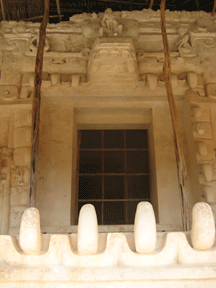
The Mayan Monster Mouth at the entrance to the tomb in the pyramid at Ek Balam. Photo courtesy of Miriam Balsley, used with permission.
This is the first time I’ve seen a scientist saying that the Mayan monster mouth sculpture symbolizes the entrance to the underworld.
All along, during my travels in Yucatan searching for corroboration of my memories of Atlantis, I’ve been wondering if the monster mouth was actually a large serpent mouth, the kind I fell into in my Atlantis past life memories. I describe my scariest memory of Atlantis in both When We Were Gods and also Arrival of the Gods in Egypt.
In other words, I wonder if the monster mouth sculptures were made by the ancient Maya as a handed down memory of visits from Atlanteans to Yucatan.
In my Atlantis past life memories, a huge serpent mouth was sticking out of the earth as if it was the entrance into the underground. It’s always baffled me that after I fell into the serpent mouth, I was next flying through space from a crumbling Atlantis to geologically safe lands.
This article is very exciting, because the scientists say they believe the monster mouth represented an entrance into the underworld, just as I’d experienced in my past life regression. It also asserts my assertion that many of the Mayan myths are actually handed down memories of the colonization of Yucatan by people from Atlantis.
Take a look at this article on the discovery of a couple of new ruin sites in southern Mexico, Two ancient Mayan cities found in Mexican jungle.
It’s especially exciting because of the following paragraphs:
They also found a facade featuring a monster-mouth doorway, which probably marked one of the main entrances to the center of the city. Photographs from the sites showed stone pyramids jutting out from beneath dense foliage.
“The entrance apparently symbolizes the entrance to a cave and to the underworld … “
Continue reading
Testimonials for Yucatan Travel
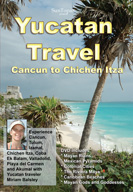
Yucatan Travel Movie
Check out these testimonials that came in support of the Yucatan Travel Movie during local showings of the DVD:
“The images are awesome!” ~ John Rich
“Wow, this is a real movie. It’s much better than I expected. It’s great. I love it!” ~ Jean C. Keating, Pulitzer-Prize-nominated author, Animal Heroes and Friends
“I like that everyone in the movie is so genuinely happy to be there rather than the canned, phoniness you see on many travelogues. Miriam is really a trip—she amuses me.” ~ Leslie, Gloucester, Virginia
Continue readingA Short Video on the Maya and the Yucatan
This video, which provides an introduction to the Maya and the Yucatan, was recorded during a talk I gave in Toronto in May of 2012. It shows where the Maya live in the Yucatan states of Mexico, the adjacent countries of Guatemala, Honduras, and Belize and also tidbits on Cancun, Mayan history, the place where the first Crystal Skull was found, and the Pyramid of Kukulkan the Feathered Serpent in Chichen Itza.
Continue readingMovie Trailer: Yucatan Travel: Cancun to Chichen Itza
Curious about what to expect when traveling in Yucatan, Mexico? My video, Yucatan Travel: Cancun to Chichen Itza explores familiar travel destinations, such as Cancun, Tulum, and Chichen Itza, as well as little-known gems such as Ek Balam, Valladolid, and Izamal. Here’s the official trailer of the travelogue:
Yucatan Travel Movie now available for easy, inexpensive download & rental on Amazon
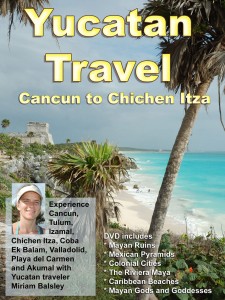 I am pleased to announce that the movie, Yucatan Travel: Cancun to Chichen Itza, is now available on Amazon for inexpensive rental or to buy downloadable.
Whether you’re interested in traveling to the Yucatan or you’re an armchair traveler who enjoys watching videos about foreign locales, you’ll enjoy Yucatan Travel: Cancun to Chichen Itza.
It is an authentic, genuine video made with a camcorder showing what you can expect if you travel to the Yucatan. Narrated by Miriam Balsley, who loves to travel in Latin American countries, she takes you both to well-publicized tourist destinations and also to relatively unknown gems, giving you a flavor of the wonderful, rich experience of travel in Yucatan.
Whether you’re after Mayan ruins, delectable native cuisine, shopping for crafts, or enjoying the turquoise water of the Riviera Maya, Yucatan Travel is for you.
Buy Downloadable Rent for 7 days
Continue readingThe Riviera Maya is in Quintana Roo in the Yucatan Peninsula
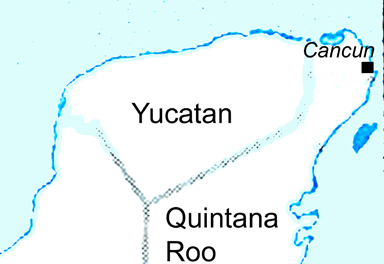
The Riviera Maya is located along the northern Caribbean coast of the Mexican state of Quintana Roo
In the map on the right, the Riviera Maya is the northern part of the Mexican state of Quintana Roo. The Riviera Maya extends along the extreme eastern coast of Quintana Roo along the Caribbean Sea (also on the right).
The popular Mayan ruins of Coba and Tulum are in Quintana Roo as well as the modern tourist towns of Playa del Carmen and Cancun.
Carol Chapman, author of the End of the World 2012 EBook.
Continue reading
The Land of the ancient Maya
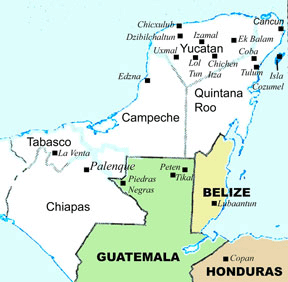
The Yucatan Peninsula showing the location of Mayan ruins sites
As you can see from the map of the Yucatan Peninsula on the right, there are Mayan ruin sites in the Mexican states of Yucatan, Quintana Roo, Campeche, Tabasco (where Tabasco Sauce comes from), and Chiapas.
There are also Mayan ruins in the countries of Guatemala, Belize, and Honduras.
Of course, the ancient Maya–the ones who wrote the Mayan prophecies and made the Mayan calendar–did not think of the area as the map looks today with separate Mexican states and separate countries.
For them, it was all the land where they lived with different centers of power where large populations lived. These are today’s Mayan ruins sites.
And today, even though this land is separated into different countries and different Mexican states, it is still the land where the Maya live–the modern-day Maya who are the descendants of the ancient Maya.
The Maya have lived in this area for thousands of years.
Carol Chapman, director/producer of the End of the World 2012 Movie and the Yucatan Travel Movie
Continue reading