The Riviera Maya is in Quintana Roo in the Yucatan Peninsula
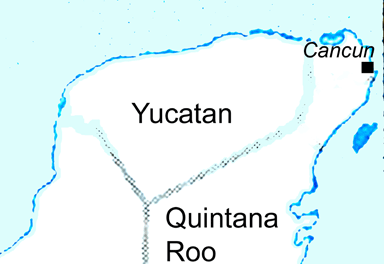
The Riviera Maya is located along the northern Caribbean coast of the Mexican state of Quintana Roo
In the map on the right, the Riviera Maya is the northern part of the Mexican state of Quintana Roo. The Riviera Maya extends along the extreme eastern coast of Quintana Roo along the Caribbean Sea (also on the right).
The popular Mayan ruins of Coba and Tulum are in Quintana Roo as well as the modern tourist towns of Playa del Carmen and Cancun.
Carol Chapman, author of the End of the World 2012 EBook.
Continue reading
2012 end of the world movie coming along …
I am excited, because I’m really close to getting the first edit of my 2012 end of the world movie complete. I just added the Hunbatz Men interview about Stele One and the December 21, 2012 date in Coba, Mexico.
Mayan Long Count Calendar date is far beyond 2012
I am delighted to discover a corroboration of a Mayan Long Count Calendar date recorded on a tall stone slab called a stele. This date is on a particular stele called Stele One at the Mayan ruin in Coba. While videotaping footage for the Yucatan Travel Movie, we spent considerable time filming Stele One, and trying to get it right, whether the date on it was 4.1 billion, billion, billion years into the future or 4.1 billion, billion, billion, billion years into the future (3 or 4 billion years). The following excerpt from Wikipedia’s 2012 Phenomenon article states definitively that it was actually 41 octillion years in the future, or perhaps, an equal distance of time into the past. Ho hm, these confusing Mayan glyphs! Anyway, I am delighted to discover that we at least got the stele right, and the 4.1 (or 41) of the date correct.
Another example is Stele 1 at Coba, which gives a date of 13.13.13.13.13.13.13.13.13.13.13.13.13.13.13.13.13.13.13.13.0.0.0.0, or twenty units above the b’ak’tun, placing it either 4.134105 × 1028 (41 octillion) years in the future,[26] or an equal distance in the past.[38] This date is 3 quintillion times the age of the universe as determined by cosmologists.
~ 2012 Phenomenon
Stele One also has a date on it that alludes to December 21, 2012.
Continue readingCoba, a Great Place to Climb a Pyramid
The Yucatan Travel Movie includes a visit to Coba, including a climb up Nohoch Mull, a very steep, 12-story tall pyramid. Coba is described in the following blog:
Another famous Mayan city is Cobá, located 40km west of Tulum. Cobá is especially fun because it has one of the few pyramids that can still be climbed. In total, the grand pyramid has over 120 steep steps that require careful footing and lots of sunscreen. The view, however, is breathtaking, as you see the surrounding jungle and peaks of smaller temples sitting between tree tops. The remainder of this ancient Mayan city is great for walking as all the temples are connected via well-maintained walking and biking paths under shady trees.
Continue readingMaps Inserted in Yucatan Travel Movie
I am so happy because I figured out how to make the maps for the Yucatan Travel Movie. These are the maps that show us traveling from Cancun to Chichen Itza, Izamal, Valladolid, Ek Balam, Coba, Playa del Carmen, Cozumel, Tulum, and Akumal, Mexico.
New Name for Yucatan Travel Movie
The Yucatan Travel Movie will be in two parts. This is Part I: Yucatan Travel: Cancun to Coba.
Coba and Birdwatching is Complete
I felt happy as I put together the scenes for the Coba section of the Yucatan Travel Video. Today, I finally finished the bird-dances-to-music. When I showed it to John, he laughed out loud and had to see it again. That made me feel so good. Many birdwatchers come to Coba because the tropical songbirds around the lakes are phenomenal. There are also crocodiles. And, of course, the ancient ruins, which are always so fascinating. The first time we visited Coba, in 1999, hardly anyone was there. The parking lot had not been paved. No tourist buses parked there. The road to the site contained potholes from one end to the other. Now, everything is paved, spiffed up, touristy and very pleasant.
Coba is the Flavor of the Day
Today I made my shot list for Coba, an especially beautiful but also wild and wierd archeological site in the Yucatan Peninsula. I especially like the plethora of wild birds chirping and yodelling in the morning. With the camcorder filming, I was thrilled when a two to three foot tall brown speckled wading bird not only gave out three large squawks, but it also pooped and then flew away . . . all on camera. It is the Coba lakes that attract the tropical birds. Most of the land surface of Yucatan Peninsula is dry and without any rivers, streams or lakes. The inhabitants have to collect rainwater or haul water up from underground.
1
2012 and Stele 1 in Coba
Today I have been looking for information on Stele 1 in Coba, Quintana Roo, Mexico, a huge Mayan ruin.
Continue reading
1
The 41.9 billion billion billion year stela & Itzamna in Tulum
Hi again,
Today, we are in Akumal, an area known as the most Americanized part of the Riviera Maya.
Strangely, as we entered the well-manicured yards, tiled sidewalks, and area of luxurious condos, my gut felt tight and I realized I felt afraid. Of what, I don’t know – that I’m not wealthy enough, cool enough, or that I couldn’t compete well enough . .. . something like that.
In the modest Mayan villages there was more of a feeling of people helping each other out.
I was unable to write yesterday because my mini laptop/netbook developed a connection problem at the more Americanized hotel where we are staying. Ironic, isn’t it?
Today, I’m in a noisy internet cafe with kids playing on a pinball machine and a slightly sticky mouse. That’s OK, at least I can communicate with you today.
Yesterday, we scourged the huge Coba ruin, to find something I could not find last year – the stela with the Long Count Calendar Date of 41.9 billion billion billion years into the future. I think we found it.
This is an important stela because it proves that the Mayan Long Count Calendar does not end on December 21, 2012, if the ancient Maya carved a date 41.9 billion billion billion years into the future. Furthermore, it proves that the ancient Maya did not believe the world would end in 2012.
Today, we were in Tulum, the gorgeous Caribbean seaside ruin, to find and videotape images of Itzamna. This time, I’m sure these are actual images of the son of the creator god, Hunab K’u. Many Tulum guides brought tourists to the place that Victor Olalde our Chichen Itza friend and guide, had told us would be there.
I am feeling pretty good. At last, I know for sure, that I have an image of Itzamna, the old wise prophet.
Carol Chapman
Copyright (c) 2009 Carol Chapman
Continue reading