Cancun did not become an official part of Mexico until 1974
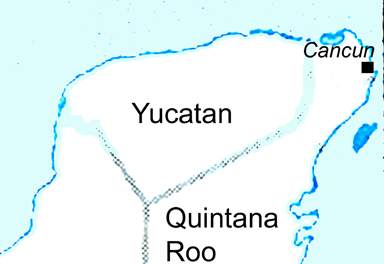
Cancun is in Quintana Roo, Mexico’s youngest state.
Quintana Roo is where Cancun is. Lots of people don’t know that Quintana Roo and Cancun did not even become a part of Mexico until 1974.
Although Quintana Roo was a territory of Mexico since 1905, it did not become an official state until October 8, 1974.
It is Mexico’s youngest state. Quintana Roo, like Yucatan, is a Mexican state in the Yucatan Peninsula, and is one of the states in Mexico where the Maya live.
Excerpted from the End of the World 2012 Book and End of the World 2012 EBook
Carol Chapman, director/producer of the End of the World 2012 Movie and the Yucatan Travel Movie
Continue readingWhere the Maya Live in Mexico
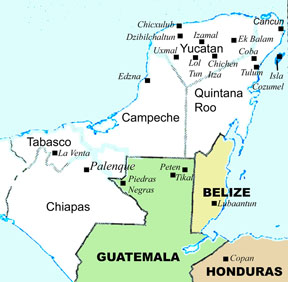
The Yucatan Peninsula
With all the information on the End of the World 2012 Mayan Prophecies, many people don’t know where the Maya live.
They live in the Yucatan Peninsula, which looks like a thumb sticking out from the “hand” of Mexico.
The top of the thumb is the state of Yucatan. Then, on either side, in the middle of the thumb are the states of Campeche and Quintana Roo.
Excerpted from the End of the World 2012 EBook and the End of the World 2012 Book.
Carol Chapman director/producer of the End of the World 2012 Movie.
Continue readingThe Location of Yucatan in Mexico
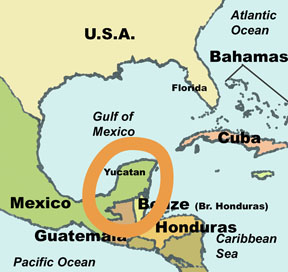
A map of Mexico showing the location of Yucatan.
My husband and I love travelling in Yucatan. It is in southern Mexico. We find it very safe and enjoyable.
We love to go to Yucatan in the depths of the winter, because it is so wonderfully warm there.
If you look at a map of Mexico, it’s like a hand and the Yucatan is like a thumb. So, that’s the whole Yucatan Peninsula.
Excerpted from the End of the World EBook and the End of the World Book.
~ Carol Chapman, director/producer of the End of the World 2012 Movie
Continue readingYucatan travelogue is also superbly discounted on Amazon for “Black Friday”
For travelers and armchair travelers alike, the Yucatan Travel Movie: Cancun to Chichen Itza is also superbly discounted on Amazon right now, from $16.95to $14.99.
Continue reading
New Page on this Blog: “Carol Chapman’s Videos” featuring the Yucatan Travel Movie
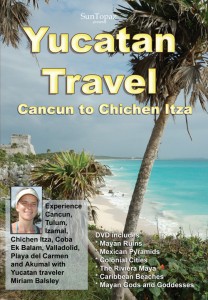
Yucatan Travel Movie DVD Case Front Cover
There’s a new page on Carol Chapman Live called, “Carol Chapman’s Videos.”
Our first feature is the Yucatan Travel Movie. For a full description including Bonus Features and About the Actor, Writers, and Director, please click here.
Available on Amazon.

Only three Maya “books” or codices survived the Spanish conquest of Yucatan
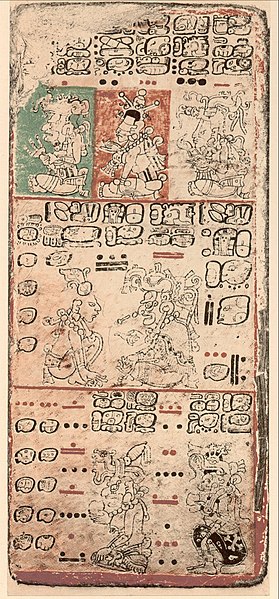
A page from the Dresden Codex showing images from Maya civilization. ~ from Wikipedia commons–this image is in the public domain because its copyright has expired.
The Maya, an indigenous people of the Yucatan Peninsula in Mexico plus Guatemala, Belize, and Honduras, made folding books written on the inside bark of certain types of fig trees.
Called “codices” (codex in the singular), many were destroyed by the Spanish conquistadors and priests.
For example, in July of 1562, Bishop Diego de Landa ordered the destruction of all of the codices in the state of Yucatan.
De Landa also destroyed a Maya temple in Izamal, using the stones from the temple to make an elegant convent, which we visit in the Yucatan Travel Movie. Izamal is a gorgeous colonial city only about an hour and a half drive from Chichen Itza and well worth the visit.
The three codices that survived the Spanish conquest are named by the location of the museum where they presently reside.
- The Dresden Codex, is housed in Germany, is made of 74 pages (39 leaves written on both sides), contains descriptions of rituals and astrological information on eclipses of the sun and moon as well as the cycles of Venus.
- To my way of thinking, the Paris Codex, in France, is the most interesting since it deals with the Maya calendar and includes prophecies for various tuns and Katuns.
- The Madrid Codex is the longest at 112 pages and is housed in Spain. Researchers believe it was put together quickly after the Spanish conquest.
Occasionally, hopelessly decayed codices are found in Maya ruins:
Continue readingGiven the rarity and importance of these books, rumors of finding new ones often develop interest. Archaeological excavations of Maya sites have turned up a number of rectangular lumps of plaster and paint flakes, most commonly in elite tombs. These lumps are the remains of codices where all the organic material has rotted away. A few of the more coherent of these lumps have been preserved, with the slim hope that some technique to be developed by future generations of archaeologists may be able to recover some information from these remains of ancient pages.
Yucatan Travel links added to this blog site
Today I added a couple of links to this blog site. They will take you to websites dealing with Yucatan Travel:
- a new blog site called, Yucatan Peninsula Travel
- a website for a new travelogue DVD, Yucatan Travel: Cancun to Chichen Itza
I love to travel in Yucatan and have been there six times. My outstanding interest is always the quest for evidence that inhabitants of the lost city of Atlantis visited Yucatan in millennia past. I have written about my experiences in my books When We Were Gods and Arrival of the Gods in Egypt.
While in Yucatan, I also began videotaping the many places we visited. These became the DVD travelogue Yucatan Travel: Cancun to Chichen Itza.
Those of us who made the Yucatan Travel DVD listed above decided to also start a blog about some of our favorite places in Yucatan. If you’ve been to that tropical paradise, we invite your comments, especially those that would be helpful to other travelers.
Continue readingVideotaping Cenote Zaci in Valladolid Yucatan
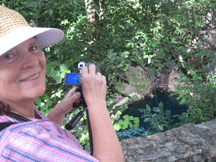
- Carol Chapman videotaping Cenote Zaci in Valladolid, Yucatan
Here I’m filming footage to be used in a future movie on Yucatan. I’m perched at the rim of Cenote Zaci in Valladolid. A cenote is a sink hole down to underground water through the limestone shelf that makes the surface of northern Yucatan. Valladolid is one of my favorite places to visit in Yucatan.
Some artifacts in Mayan ruins discovered by using intuition
In yesterday’s post, I referred to August and Alice LePlongeon, explorers of the Mayan ruins in Yucatan. While we were in Yucatan filming the Yucatan Travel Movie, we visited Hacienda Chichen, the place where many of the original explorers of Chichen Itza stayed. There we learned of Alice Le Plongeon’s psychic talents and how she had found a Chac Moll buried deep in the ground purely by intuition.
Continue readingAtlantis and the Yucatan Travel Movie
You may have noticed that I have written books on finding evidence of Atlanteans in Egypt and Yucatan. I’ve also made a movie, which is almost ready to be distributed, on Yucatan Travel. Atlantis and Yucatan Travel seem to be separate subjects. Here’s how it came about: It turned out that while I was doing research in Yucatan for the books, I couldn’t find DVDs to show me what to expect while traveling in Yucatan. As a result, I decided to videotape my experiences in Yucatan in the hopes of being helpful to other people who want to know what to expect. That’s how the Yucatan Travel Movie came about.
Continue reading